Program Highlights
This interactive grade 6 program immerses students in exploring climate change challenges and innovative solutions. It is designed to align with the grade 6 science unit on renewable and non-renewable energy. The program adopts an object-based, skills-driven approach that strengthens students’ observation and critical thinking skills.
Through engaging activities, students distinguish weather from climate and are introduced to climate zones. Using multisensory observation, discussion, inquiry, and systematic recording, students examine how climate change impacts various regions. By experimenting with renewable energy kits, students investigate the potential of clean energy and where in Nova Scotia these technologies may be applied.
Curriculum Outcome Links
Specific Curriculum Outcomes
Grade 5 – Weather
- Learners will investigate how the weather impacts daily life.
- Investigate the significance of seasonal cycles and natural seasonal events.
Grade 6 – Electricity
- Learners will evaluate renewable and non-renewable energy sources.
- Compare renewable and non-renewable energy.
- Analyze the impact of electrical energy consumption.
Program Length
90 min
Program Capacity
- 2 classes (60 students maximum)
- 1 chaperone for every 5 students
Cost
The charge for this program is $3.50 per student, including tax. The teachers are admitted free of charge. One chaperone is admitted free for every five students (1:5 ratio).
Activities
10 minutes: Introduction
The program begins with an introduction to the difference between climate & weather. Students are introduced to the concept of climate zones and the characteristics that define them through an interactive activity. The class will be divided into two groups and take part in both of the following activities.
35 minutes: Science on a Sphere
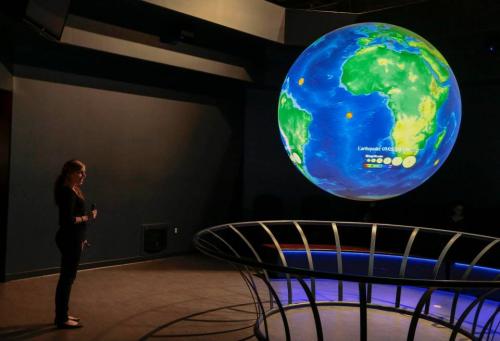
The museum’s Science on a Sphere technology illustrates the greenhouse effect and how human activity has affected it, driving global climate change. Students will observe and record global predictions of temperature and precipitation changes to highlight the wide-ranging nature of these changes.
35 minutes: Renewable Energy Activity
This section of the program helps students recognize how countries can find climate change solutions using renewable energy turbine kits as an example. In small groups, students will rotate through a series of stations with different renewable energy scenarios. Through observation and experimentation, students identify the factors that most effectively harness wind power and record their findings.
5 minutes: Conclusion
In their respective groups, students will discuss and summarize the material covered during their activities.
Information and Reservations
To book this program, please email mnhgroups@novascotia.ca