Nova Scotia Frogs
Nova Scotia is home to eight species of frogs. With the exception to toads, frog skin is smooth and moist. Some parts of their life cycles happen in the water. Frogs are amphibians.
Frog faces have two large, exposed eardrums called the tympanum. They have two bulging eyes with clear lids and an inflatable vocal sac. The vocal sac is located near the throat or along either side of the throat. It is used to make vocalizations sound louder and stronger during the mating season. Frog mating season happens in the springtime and occasionally during the summer.
In the spring and early summer, frogs will gather in wet habitats for mating season. The males arrive first and use their vocalizations to get the attention of females. Each species has its own unique call and is distinctive enough to recognize from the rest. Once a female locates and joins with a male, the male will climb on top of the female in a mating position called amplexus. After amplexus, which is the fertilization process, the eggs will quickly hatch into tailed tadpoles. Development into adult frogs can take from two months up to two years depending on the species and environmental conditions. Frogs, frog eggs and tadpoles are generally vulnerable to predators. They are eaten by large beetles, turtles, birds, snakes, fish and mammals.
The eastern American toad, spring peeper, green frog, wood frog, leopard frog and pickerel frog are found across Nova Scotia. Mink frogs are only known to live in a few areas of the Province, and there are no known reports of bullfrogs on Cape Breton Island.

Photo Caption
Bullfrog
Nova Scotia Salamanders
Salamanders are secretive, harmless creatures. Their permanent smiles and delicate little toes will win your heart once you take that first curious look.
It’s not uncommon to mistake a salamander for a lizard, but there a few differences. Salamanders are tailed amphibians, and Nova Scotia does not have any wild species of lizard. Salamanders have smooth, moist skin, and they’re unable to bite.
Salamanders are common. There are approximately 600 known species around the world, and Nova Scotia is home to five of them. Salamanders can be seen in the spring during breeding season, after hibernation.
Their diet consists of various insects, worms, snail, spiders and slugs. They use sight and smell to find prey. Salamanders make no sounds and cannot hear, instead, they feel vibrations in the ground with their front legs and lower jaw.
Mating Season
In the spring, yellow-spotted and blue-spotted salamanders gather in woodland ponds or roadside ditches to breed. Males court females with an underwater display. The male then places a small white package of sperm (called a spermatophore) near a female. If she is interested, she will take the spermatophore and hold it in her abdomen until she is ready to lay the eggs. Newts will also breed in ponds, but red-backed salamanders and four-toed salamanders lay their eggs on land. Salamander larvae are slimmer than frog tadpoles, with flattened heads and feathery external gills - a respiratory organ located on either side of the head.

Photo Caption
Yellow-spotted salamander
Nova Scotia Snakes
Nova Scotia is home to five species of snakes. None of these snakes are poisonous or venomous, and we rarely see them reach more than a meter in length. Despite this, snakes are still a source of fear for many individuals. For as long as humans and snakes have cohabitated, snakes have suffered a bad reputation rife with myths and falsehoods. They do not sting with their tongues or milk cows, and they’re unable to bite their own tails, or curl up like hoops to roll down hills. What they do have are some wonderful adaptations to help them thrive in their natural environments!
Snakes in Nova Scotia hibernate over the winter months, often in large groups. Breeding typically occurs in the spring. Some of our snake species lay eggs, while others partake in live birth. Animals that predate snakes include large birds, foxes, raccoons, bears, and domestic cats.

Photo Caption
Maritime Garter Snake
Nova Scotia Turtles
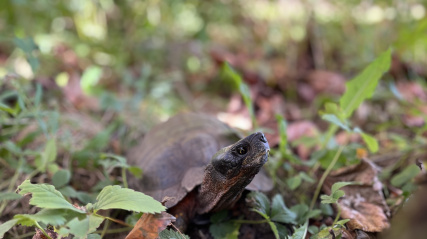
Turtles are reptiles. Typically, the first thought that comes to mind when you think of turtles are their shells. The top part of the shell is called the carapace, and the bottom part is the plastron. Other features include dry, scaley skin, a sharp-edged beak instead of teeth, good eyesight and hearing, and leathery-shelled eggs, which they bury in soft substrate like sand.
There are over 300 species of turtles currently known around the world, with 7 of those species residing in Nova Scotia. Three of these are giant marine turtles: The Atlantic Loggerhead, the Atlantic Ridley, and the Atlantic Leatherback. These turtles are often seen from boats and do occasionally get tangled in fishing gear. While they do visit our waters every summer, these species nest in more tropical regions of the world. All marine turtles are considered endangered species.
In addition to the three marine turtles mentioned above, Nova Scotia has four species found in freshwater habitats. A name used to describe freshwater turtles is “terrapins”, and those species that live entirely on land are called “tortoises”, although we have no wild tortoises in Nova Scotia. While adult turtles have very few predators, other animals like crows, bears and raccoons will dig up turtle nests to eat the eggs and hatchlings. All four turtle species in the Province are considered “at risk”.

Photo Caption
Eastern Painted Turtle